
The Fujian was launched at a brief ceremony held at the Shanghai shipyard, the official media reported from the eastern metropolis.

India is playing its South China Sea card by restarting oil exploration off Vietnam coast despite China's objections as a calculated geopolitical move to force Beijing to make "compromises" on border issue and its close ties with Pakistan, a state-run Chinese think-tank has said.

Experts said the tensions have added to a sense of apprehension in the United States, Europe and parts of Asia that China will engage in more aggressive behaviour in pursuit of its territorial interests, which in turn has raised the possibility of a serious and coordinated pushback by leading global players.
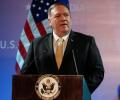
He said the actions of the ruling Chinese Communist Party meant there were 'threats to India, threats to Vietnam, threats to Malaysia, Indonesia and the South China Sea challenge'.

'If the Chinese intent is to be gauged based on its aggression in the South China Sea, greater forays in the Indian Ocean, a hawk's attitude towards Taiwan, flying its fighters repeatedly over the Senkaku islands in the East China Sea and creating strategic assets globally, there would be a requirement for strategic partnerships for India,' says Brigadier S K Chatterji (retd).
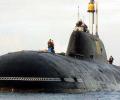
China on Tuesday angrily denounced the nuclear-powered submarine deal announced by the US, UK and Australia, saying the pact violates the Non-Proliferation Treaty (NPT) and the three countries are travelling "further down the dangerous and wrong path."

If the aim is to become a player with some strategic space of its own, not just in the Indian Ocean region but also in the adjoining region, then greater interaction with China is desirable, even necessary.

After the 1962 War with China, there was a demand to forge greater defence cooperation between India and the West. One such voice was that of Sudhir Ghosh, a distinguished MP, to tie up strategic cooperation with the USA immediately after the Chinese attack on India, recalls Rup Narayan Das.
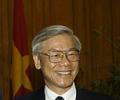
India-Vietnam relationship has its own imperatives and dynamism. In India's look east policy Vietnam has been the major pivot, at least in terms of security and strategic imperatives, says Rup Narayan Das.
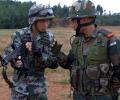
The statement of Commander of US Indo-Pacific Command Admiral John Aquilino on Wednesday came ahead of the 15th round of high-level military talks between India and China on March 11.

'By causing military humiliation of India it intends to send a signal to other Asian countries to toe the Chinese line,' argues Colonel Anil A Athale (retd).

The US "Indo-Pacific Strategy" is bound to be a failed strategy, Wang said in the comments posted by the Chinese foreign ministry on its website.

Although the Malabar is a routine exercise which has been carried out for several years now, security experts attach a lot of traction to it in view of China's assertive behaviour in the South China Sea, observes Rup Narayan Das.

China also said that it was opposed to any third-party involvement in the resolution of the Sino-India boundary disputes.
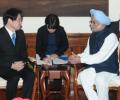
Engaged in a territorial dispute with China, Japan on Thursday sought to rope in India's support over "the recent Chinese provocative actions" saying a message needs to be sent to it collectively that status quo cannot be changed by force.
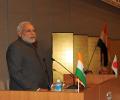
Prime Minister Narendra Modi on Monday deplored the "expansionist" tendency among some countries which "encroach" upon seas of others, in oblique comments against China which has a maritime dispute with Japan.

Key to China's decision regarding Taiwan will be its leadership's assessment whether the US will come to Taiwan's defence, explains Jayadeva Ranade, the former senior RA&W officer and China expert.
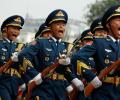
'We are beginning to see that the rest of the world will not simply accept the domination of one power'

The hike in the budget is the lowest increment in recent years apparently due to the heavy disruption caused to its economy by the COVID-19, according to the official media.
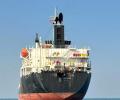
The world needs to wake up to this new dimension of war at sea and be prepared to face the 'unknown enemy' who have the advantage of attacking at their choice of location and time, cautions Commodore Venugopal Menon (retd).

"The message is clear. We're not going to stand by and let China or anyone else take the reins in terms of being the most powerful, dominant force, whether it's in that region or over here," White House Chief of Staff Mark Meadows told Fox News.

Reports (not denied by India) that the USA had 'for the first time provided real-time details to their Indian counterparts on the Chinese positions and force strength in advance of a PLA incursion' into Tawang at the LAC in December 2022, helping India thwart China's expansionist designs, show how operationally effective the USA-India friendship has become on the ground. A engaging excerpt from Sreeram Chaulia's must-read new book, Friends: India's Closest Strategic Partners.

China's aggressive posturing over maritime boundaries has caused East Asian countries to look at other powers for support.
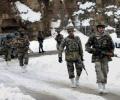
Experts have said the economic cost of China's misadventure in the last couple of months in eastern Ladakh and South China will be "massive" as it has "exposed" Beijing's "real face" when the entire world is fighting coronavirus.

China will increase its defence spending by "around seven per cent" this year, as it vowed to guard against "outside meddling" in its territorial disputes.

India is no longer shying away from playing a role on the regional and international stages and is willing to don a bigger role in regional politics. It is showing traits of a responsible stakeholder in the regional security dynamics, says Dr Rahul Mishra.
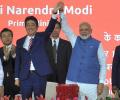
Chinese foreign ministry spokesperson Hua Chunying, while reacting to Japan's plans to step up investments in the northeastern states, told the media that China is opposed to any foreign investment in the areas where it has disputes with India.

PM Modi went to New York this time not to engage in polemics, but to find solutions to global problems. He made some progress on several matters, even on reform of the UN Security Council, when the US made a major concession for the first time that six permanent members without veto, including India, could be considered
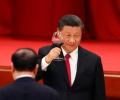
He claimed China has a policy of keeping "hot spots like Taiwan, South China Sea and Tawang burning" in order to divert attention to its own failings.
Seven Chinese warships, including two destroyers, were sighted on Tuesday in waters off a Japanese island, according to the defence ministry, as tension mounted between the two Asian giants over territorial disputes. The naval ships passed the contiguous zone, a band of water just outside Japan's territorial waters, which are governed by international maritime law.
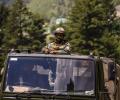
He said that following a build-up of troops, multiple transgressions and attempts to unilaterally change facts on the ground by China, there have been several levels of talks and a fair amount of communication to ensure that the matter can be resolved through negotiation and diplomacy.

Foreign portfolio investors (FPIs) have net sold domestic shares worth over $10 billion so far this month amid a shift to China, which not only offers attractive valuations compared to India but has also announced several measures to support the economy and the stock market in recent weeks. If the trend doesn't reverse, this will be the first time that overseas funds will yank out more than $10 billion from Indian equity markets in a month.

The Summit comes at a time when China is flexing its muscle to tighten its grip over the disputed South China Sea.

China is pulling out all the stops to give a 'state visit-plus' reception to Trump on his maiden visit.

Chinese President Xi Jinping has announced that the 2.3 million strong People's Liberation Army, the world's largest, will be trimmed by three lakh.
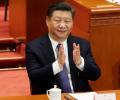
"We should safeguard the sovereignty and territorial integrity of the country and achieve full unification of the motherland. This is the aspiration of all Chinese people. This is also in line with fundamental of the Chinese nation," he said in an apparent reference to Taiwan which China claims as part of it.

Military clashes between China and Japan cannot be ruled out and the People's Liberation Army will fight back if provoked, a top Chinese official said on Monday.
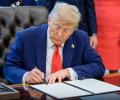
The collective West has always opposed strong leaders and economic development in India, asserts Colonel Anil A Athale (retd).
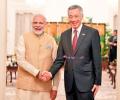
Modi hailed the close defence cooperation between the two countries and welcomed the completion of the logistics agreement between the two navies.

Four-nation grouping Quad on Tuesday launched a major new initiative for the Indo-Pacific that allows the partner countries to fully monitor the waters on their shores and help ensure peace and stability in the region, a move that comes amid China's increasingly intimidatory behaviour.
